Do I Really Need to Hire an Interior Designer?
Most homeowners don’t start planning a home renovation wondering if they want the design to look incredible. They start by wondering: Do I really need to hire an interior designer? Can’t our contractor handle it? What exactly does a designer do? Is it worth the investment? These are smart, practical questions, and they deserve clear answers. In this post, we’re pulling back the curtain on the design process by sharing a story of two renovations. Although this story portrays fictitious clients, their stories represent realities we have witnessed firsthand. We want to show you what truly happens behind the scenes, why structure matters more than inspiration alone, and how hiring a designer isn’t an added luxury; it’s the smartest way to protect your home, your budget, and your peace of mind.

Our story begins with two clients; we’ll call them Emily and Daniel. Both renovated their homes last year. They both had inspiration photos saved. They both had healthy budgets.
They both wanted something that felt elevated, cohesive, and timeless.
But their experiences couldn’t have been more different.
Maybe you can relate…
Emily started planning her renovation the way most homeowners do – late at night, scrolling.
She saved Pinterest boards for every room, scrolled endlessly on Instagram, and even took screenshots of luxury homes she found on Zillow. Emily knew exactly how she wanted her home to feel: organic, warm, collected, and modern without being cold.
Not knowing exactly where to begin, she called a few contractors and hired the first one to respond. At first, Emily was amazed by how quickly the project was coming along. She watched as they began installing the frame around the bathtub and laying out the kitchen cabinetry. The stone around the fireplace was quickly coming to life.
But before Emily knew it… decisions started to feel urgent. Tile samples for the bathroom arrived one at a time, and none of the selected options seemed to fit within the frame. The contractor was running out of time. In the rush, Emily selected the lighting fixture from a website photo, and the sofa was ordered without measuring out the available space.
And so, everything began to unravel.
The sofa didn’t fit in the room properly, so you could barely walk around it. The fireplace stone was beautiful, but completely clashed with the flooring.
Every decision Emily made wasn’t necessarily wrong, but they weren’t working together. Before she knew it, her budget was blown out of the water. Not because she chose luxury pieces, but because she had to make costly corrections.
Emily’s story is the reality many homeowners face when there is no master plan or technical oversight of specifications. Emily’s story might be your story.
But there is a better way.

The Designed Experience
Daniel approached his renovation differently.
After doing some research, Daniel discovered a Renovation Prep Worksheet that helped him think through all the important details before doing anything else. He quickly recognized that working with a professional designer would make his experience better than he could imagine. So, before a single trade was scheduled, before a wall was drawn, before cabinetry was quoted — he decided to hire an interior designer and set up a Concept Direction Meeting.
This was a virtual conversation where Daniel and the designer reviewed the inspiration he had been compiling. The designer moved the conversation beyond style and helped uncover a deeper understanding of how Daniel wanted to live in his home.
The designer asked questions like:
“How often do you host?”
“Where do your kids’ backpacks land?”
“Do you want a more dramatic or serene feeling?”
“Is your workspace aligned with the strongest natural light during your most productive hours?
That meeting wasn’t about picking finishes or getting into the details. It focused on defining the project’s soul, providing clear direction for the design process to begin.
The Concept Deck: Where Vision Becomes Structure
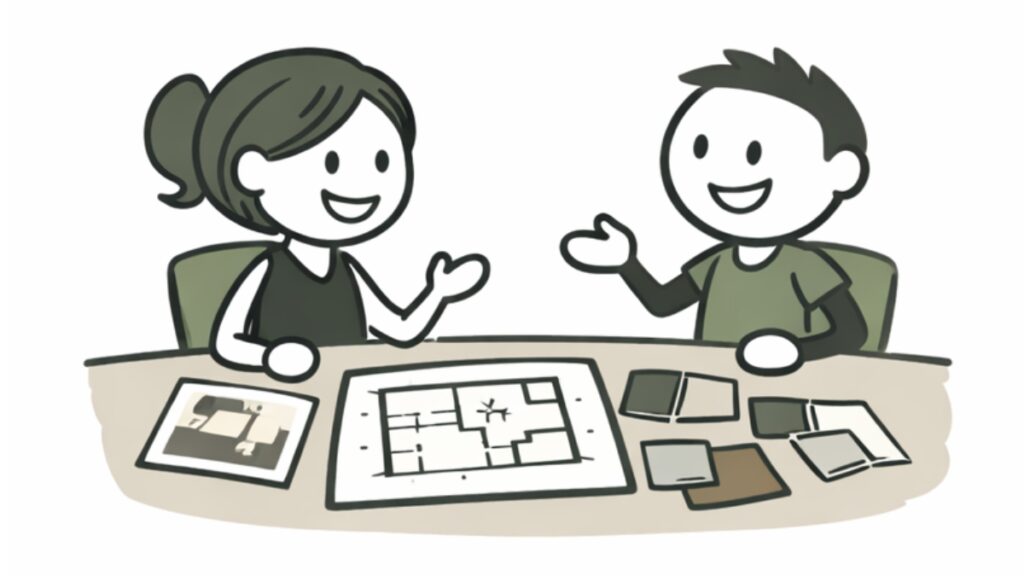
A few weeks later, they gathered in person for a Concept Deck Presentation Meeting. This was not a pile of random samples or a scattered mood board. This was a professionally articulated direction for the project.
Daniel was amazed when the designer presented a scaled 2D floor plan. The designer had thought through every detail: furniture footprints, ceiling clearances, sightlines, and room flow.
The designer explained that “this floor plan is the mathematical backbone of your home. In the next phase, my role is to specify the exact pieces that meet these dimensions while ensuring comfort, fabric durability, and aesthetic harmony work together. One wrong inch on a custom order can ruin a room’s flow. That’s why I manage the technical specifications from here on out.”
Daniel’s astonishment continued to grow as the designer walked him through the Vision Board, Key Elevations, and the Tactile Tray. The Vision Board accurately captured the mood, color palettes, textures, and lighting discussed in the concept meeting. Drawings of key project elements, like the custom built-ins, came to life in the Key Elevations. And to top the experience off, Daniel was able to truly get a feel for how the elements would come together as he explored the textiles and wood finishes displayed on the tactile tray.
The end result of the project was so clear, and Daniel couldn’t wait to see the end result.
The Investment Roadmap: The Part No One Talks About
Before Phase 2 ever began, Daniel received something most homeowners never do: a detailed Investment Blueprint.
This high-level financial roadmap outlined projected investment ranges by room, the key elements included in each space, and the trade specialists likely required to execute the design. It wasn’t an exact number; it was informed clarity.
When Daniel first imagined this renovation, his anxiety centered around the unknowns: How much would it really cost? Where would the money go?
The Investment Blueprint replaced uncertainty with structure. With realistic ranges and a clear scope in place, he was able to move forward confidently rather than reactively.
Because true luxury isn’t just beautiful design. It’s clarity before commitment.
The Hidden Value: Why You Need to Hire an Interior Designer
When Phase 2 began, the difference became even more pronounced.
Selections were made with intention, site visits caught discrepancies before they became change orders, technical specifications were managed, custom orders were protected, and install days were orchestrated with ease.
This is the part clients don’t see when they ask:
“Do I really need a designer?”
You’re not paying for someone to choose a pillow.
You’re going to hire an interior designer to:
- Protect the math.
- Protect the aesthetic.
- Protect the budget.
- Protect the outcome.
Emily and Daniel could not have had more different renovation experiences. It’s common for homeowners to bypass hiring a designer because they think they are saving money or saving time. In reality, the designer will not only help you create a home that exceeds your design expectations, but they will also protect your financial investment and save you so much time in the long run. Not to mention, you will actually enjoy the process rather than dread making another decision.

Luxury isn’t about spending more. It’s about removing friction and creating an unforgettable, anxiety-free experience.
Are you ready to make your design dreams a reality?